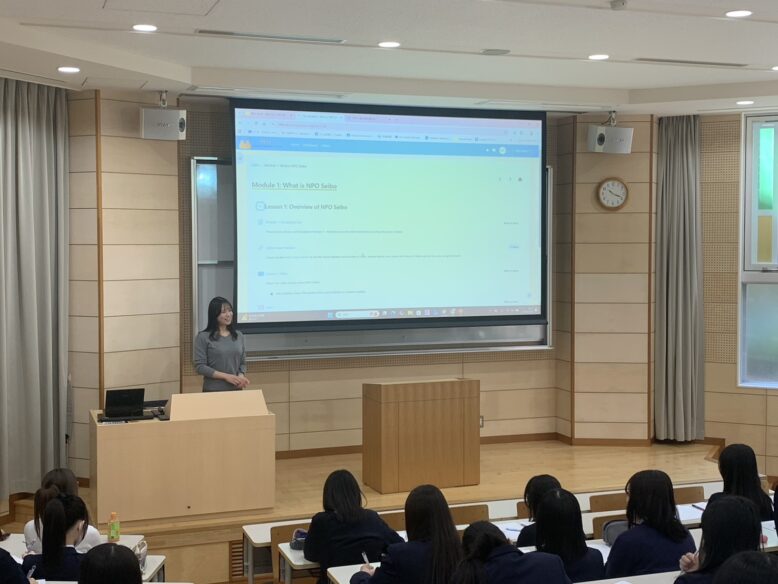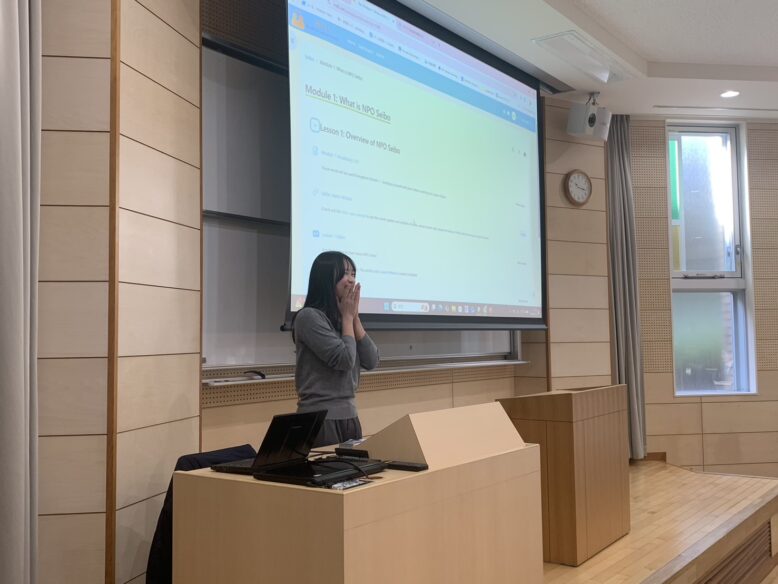


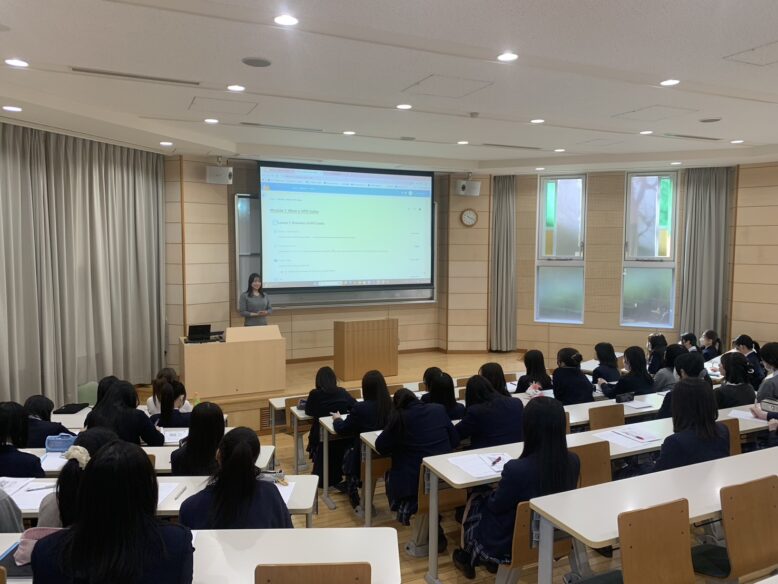
On January 30, Seibo had the opportunity to give a talk to third-year high school students at Salesian International School Setagaya, focusing on career education and international support.
In addition, we welcomed a university student interning from Florida State University and a student from Sophia University, both of whom shared their own experiences. Through these contributions, we were able to offer international perspectives and inspiration from students close in age to the audience.
The main themes of the session included the idea that working for an NPO can be a realistic career option for today’s high school students, as well as discussions around social issues often described as a “value-driven economy.” We explored how work that addresses social challenges—such as anxiety and uncertainty—can create economic impact, build empathy, and be carried out sustainably.
We also spoke to students who may still have a vague image of going to university or entering the workforce. Rather than relying on traditional self-analysis, we emphasized the importance of engaging in activities, meeting diverse people on university campuses, and receiving feedback from others. Through these experiences, students can gradually come to understand their own value and direction.
In this context, the voices of the university students were especially powerful.
The student from Florida State University is majoring in Japanese as a second language and studying Environmental Science. She shared that exploring her field within Japan’s unique cultural context, while engaging in charity work for Malawi in Africa, has allowed her to learn practically about global sustainability and future human capital through school meal support initiatives.
Meanwhile, the student from Sophia University spoke about her journey: influenced by her education at a Catholic high school, she developed an interest in volunteering and international cooperation. After visiting Rwanda during her university studies, she decided to transfer departments and specialize in African studies.
What both students’ stories highlight is the importance of being honest with one’s own feelings, valuing encounters with others, and taking proactive, passionate action in fields they feel deeply committed to.
Seibo’s approach to career education is distinctive in that it is delivered through the involvement of many university students and draws on our connections as a business-oriented NPO with partners in the UK and Malawi. We hope to continue sharing meaningful messages with students and expanding these opportunities in the future.
Finally, at the end of the lecture, students were introduced to an online, on-demand course by the university students in charge of the program. The course allows participants to learn about the significance of school meal support in Malawi, the social business models that make such initiatives possible, concrete case studies, and how to move toward practical action.
The course was developed collaboratively by international interns and Seibo’s domestic volunteers. It is designed as an accessible entry point, enabling many people to first learn about our work and then begin deeper, more meaningful engagement.
For the details, please find the information from here.